
The science behind sentimentality for...selling a house
How a house becomes a home: Sociology has identified an empirical basis for "place attachment" and neuroscience has found where in the brain it develops. Not everyone, however, is affected equally.

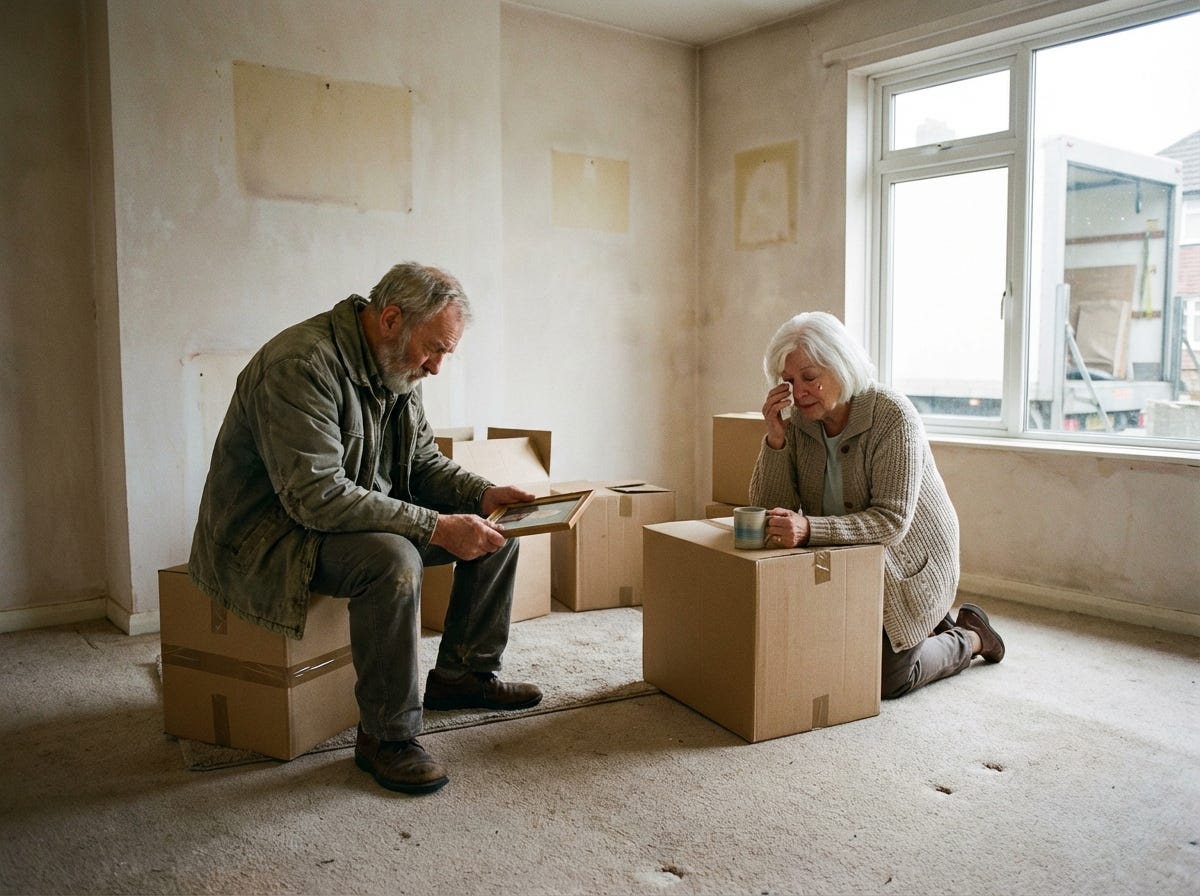
It’s sometimes difficult to say goodbye. It’s particularly difficult when you’ve been intimate, with contact nearly every day for nearly 47 years. And it may seem somewhat silly on learning that I’m talking about saying goodbye to my house, or, more precisely, my home. Yes, not a dear friend or relative, not a pet, but an inanimate object consisting mostly of wood and wallboard.
There is, of course, a difference between a house and a home. The former is a physical building or structure—bricks and mortar, or, in my case, lumber and nails. It is a place of shelter. A home, on the other hand, is a place where one not only lives but feels comfortable and, most critically, holds an emotional attachment. A house is a tangible object, while a home represents security, belonging, and personal, emotional connections.1
My quest to deal with these feelings led me to quite a bit of research, through some often opaque literature in psychology, sociology, and even neuroscience, that helped explain my—and perhaps your—attachment to a house (which could include an apartment). The well-developed findings even liken the emotion associated with leaving a home to the grief one can feel at the death of a loved one, and for many of the same triggers: the memories a home may hold with the spirit of those who are gone.
Place attachment
The scientific foundation here is a field called place attachment — the emotional bond people form with specific locations. Research has found that place attachments bring feelings of belonging, security, and relaxation, while also supporting our sense of personal identity and growth.2
The research identifies multiple factors that influence the strength of place attachment. The first two below were obvious to me, and I had already recognized as likely being amplifying factors in my separation anxiety.
First, the long length of residence. Subtracting perhaps several hundred days and nights I was away for business travel and vacations, I calculate I spent more than 17,000 nights in my home. It is rather intuitive that people who have lived longer in a place feel greater attachment to it. Forty-seven years is extraordinary by any standard. Studies find that prolonging one’s stay at a place intensifies one’s emotional bond, which in turn causes a place to become more a part of one’s conceptual and extended self.3
The second intuitive factor is our life milestones and autobiographical memory. Some places are “transformative places” — those associated with autobiographical recall that are attached to memories as places of importance. In my case, my house is saturated with this: my long-time romantic partner leaving her home to move to mine, our subsequent marriage, and then raising a child. In addition, the reason I came to Cambridge and bought this house in the first place was to start a new job that turned out to be pivotal in my career, hence a close association has formed between this domicile and, I’ll use that term again, self. (If you didn’t look at footnote 3 before, maybe worth looking now). These are not incidental memories but definitional ones — they are part of who I am. You would have your own set of milestones and memories.
The research also discusses “social density,” a term not in my everyday vocabulary. When we feel socially connected within a place, our emotional bond with the physical environment strengthens. That is, I haven’t just lived here. I’ve hosted hundreds, perhaps thousands of people in that space. Parents, a grandparent, uncles, aunts, cousins, work colleagues, neighbors, local friends, friends visiting from afar, often staying a few days. The house has become a vessel for an entire social world. Researchers specifically identify that “socializing places” can generate especially powerful attachment.
Finally, I can appreciate the observation that the house has become the place of identity. Place identity has been defined as a component of personal identity — a process by which, through interaction with a place, we may describe ourselves as belonging to a specific place. After nearly five decades, my house may have actually merged into my self-concept; it is part of it. Nonetheless, I’m not sure how much I buy into this notion of house as me, but perhaps it lurks there in my basal ganglia.
The neuroscience nostalgia
As I’ve learned, these notions of place attachment are backed by real neuroscience. The feeling I’m experiencing when I walk through the rooms of the house and feel the weight of the memories in each has a specific name — nostalgia — and, much to my relief, has actually been confirmed by brain mapping. (Full transparency: not mine.) The word itself is telling: the term was first identified by a Swiss medical student, Johannes Hofer, in 1688, whom you no doubt recall. He applied it to describe the extreme homesickness experienced by Swiss mercenaries stationed in distant regions. Hofer characterized it as a neurological disease caused by a brain deficiency. Of course, we now understand it far better.
To summarize (so you don’t need to read all the Social Cognative and Affective Neuroscience journal articles), “nostalgia arises from tender and yearnful reflection on meaningful life events or important persons from one’s past.” It involves the parts of the brain associated with self-reflection, autobiographical memory, emotion regulation, and reward processing.
The fact that nostalgia involves the reward system is especially significant. Memory and reward systems together produce nostalgic experiences in the brain, and nostalgia intensity is predicted by the age of memories, happiness, attachment, sentimentality, personal significance, and age of the last recall. This explains why walking into my daughter’s old bedroom, or sitting at the dining room table where we often hosted animated meals with current and now long-dead relatives and friends, produces something that feels incongruously sweet and painful. It is, the researchers assure us, a genuine neurological cocktail of memory retrieval, reward signals, and emotional regulation all at once.
What I thought was a simple term to describe a fondness for something in the past is more complex. Nostalgia apparently boosts self-esteem and self-positivity, increases meaning in life, and fosters social connectedness. This is why, even when it hurts, many people find themselves seeking nostalgic engagement with a home they’re leaving rather than avoiding it. Who knew?
The Grief Dimension: Losing People Through the Loss of a Place
Perhaps the most poignant dimension of my trip into sentimentality was the association of grief—which we typically apply to our feelings on the death of someone we felt close to—with the loss of a home.
Probably the only mystical experience in my long life occurred in one of the last visits to the home I grew up in. I was four years old when my parents moved into a new red-brick row house on the far western edge of Philadelphia. Although I moved to an apartment after college and grad school, I continued to visit at least weekly for dinner (and to do my laundry) as well as for holidays and special occasion meals with the extended family. Even after moving to Cambridge and my father's death, I continued to visit several times a year, staying in the house. So that house—that home—stored, like a social battery, 51 years of memories and nostalgia.
By late 1999, my mother had moved. Although all her personal effects went with her, she didn’t take all of the furniture. Some, like the dining room set, go back decades. Early one morning, a few weeks before it was to be sold, I came downstairs and sat on the couch in the still living room. As I stared into the adjacent dining room, I got to thinking of the many dinners there, people talking over each other, passing food back and forth, laughing. Suddenly, I could almost see them, apparitions floating out of the dining room. It lasted just seconds. I tried to will it to go on, but once I became too conscious of what was happening, it was just a quiet, empty room again.
What I seemed to be experiencing was a form of what I found described as “proxy grief.” That house—and now my current one—served effectively as a physical repository for the people I’ve loved. Leaving it means, in a concrete sense, leaving the last remaining site where those presences can be felt. The rooms hold the dead and the gone in a way that no other location can. This isn’t just sentimental fantasy; it’s how autobiographical memory is spatially organized in the brain (For the technically minded, the hippocampus encodes memories, in large part, through spatial context).
Thus, leaving the house may reactivate those feelings precisely because the spatial cues that trigger those memories will soon be gone.
Why Some People Feel This More Than Others
How well you can identify with this sentimentality may depend on your individual experiences as well as your station in life. If you’re over 70, you’ll be more likely to understand what I’ve tried to describe than if you're under, oh, 40. Older adults often develop the deepest place attachments, as our identity becomes progressively intertwined with long-inhabited environments. There is, I suppose, also a practical dimension: for many older seniors, their social world may contract, making the remaining anchors — including physical ones — more dominant.
It may further correlate with how much you moved around. Military families and many upwardly mobile corporate executives often have to move regularly. Academics as well, at least early in their careers, may have multiple stops. One friend I was discussing this place attachment notion with remained in one city while raising his family, but moved several times over the years. As a result, he reported he didn’t feel nostalgic about leaving any of them, though he did understand what I’ve described here when his home of upbringing was sold. Forming an attachment to a house requires time to accumulate memories in those walls.
I don’t want to get Freudian here, though it’s probably safe to assume that we differ in the degree to which we developed secure, anxious, or avoidant attachment patterns in early life. The extent of attachment has been shown to be similar to psychological adjustment after bereavement. Those with anxious attachment styles would tend to feel more intense distress around all forms of loss, including the loss of a place.
There may also be a cultural dimension. “In many South Asian cultures, the ancestral home carries deep generational significance, with people maintaining emotional ties even decades after relocating, because those places represent lineage, ritual, and social identity. In contrast, some cultures prioritize mobility and adaptation. Nomadic traditions, for example, define belonging through movement rather than fixed location.”
Does any of this help?
I went down this rabbit hole to help understand why I was having these strong feelings of sentimentality, nostalgia, and—as I’ve learned—even grief. Many of us in the boomer generation have recently been there or will soon. The rest of you will—I hope—get to this point eventually. Some will just pack up and move to a retirement condo in Florida or a continuing care community in Philadelphia, complaining only about the hassle of moving. Others, however, who have developed this “place attachment” will experience stronger emotions when leaving the house, which has become a home and a storage depot for memories.
What I now understand is that what I’m experiencing, solidly in this second group, has a modicum of scientific backing that clearly says that what we are feeling is not merely sentimental in any dismissive sense. Rather, it is the product of deeply wired neurological systems for memory, reward, identity, and attachment operating exactly as they were designed to. A house in which I have lived for 47 years, raised a family, and hosted the full arc of a social life isn't an inanimate object in any psychologically meaningful sense. It has become a physical extension of myself and my relationships with the living and the dead. Grieving its loss is entirely rational.
This formulation may explain the revisionism in recent years to refer to those formerly known as “homeless” now as “the unhoused.” Both would seem applicable, as one without a physical shelter is unlikely to develop the accouterments of a home.
As is frequently the case, I must give a shout-out to Anthropic’s Claude 4.6 AI platform, which has been a tireless research assistant herein. I am not compensated for this shout-out. I’m just genuinely impressed.
What "self " is is a long discussion for another day. For now, just think of it as a sense of identity, encompassing your personality, memories, emotions, and physical being. Oh, that doesn’t help?
I totally concur with this pancake! I won’t discuss your scientific Claude references but the emotional connection with a home is something that I have experienced. I cried deep wrenching sobs at leaving our home of 43 years. We had to leave our home in the early months of the pandemic only 9 weeks after my beloved mother’s passing which also happened in the beginning of the pandemic. I had to clear out her tiny nursing home room which after only 6 years was filled with memories of Saturday afternoon music, memories and yes even dancing. Her loss, the nursing home room loss and weeks later packing up our home and moving to a blank canvas condo was a wrenching experience. I’m not sure if I have recovered to this day. The layout of our new “home“ required some new furniture but I have refused to give up the inanimate dining room table that has been a place of gathering for almost all of my grandparents and their descendants.
I still try hard to establish a similar connection with our new home of almost 6 years but find myself dreaming many nights about my childhood home and the home that we “just” vacated. In fact I plan to drive by today to visit the cherry tree blossoming right now on “my” front lawn!
Having moved often, I have no such sentimental attachment to any home. Rather, a house for me is a place to live and an economic investment.