
Hardware as a service
First, it was Microsoft Office by annual subscription. Now, printers, financial applications, televisions and exercise equipment could lose functionality without paying month after month.

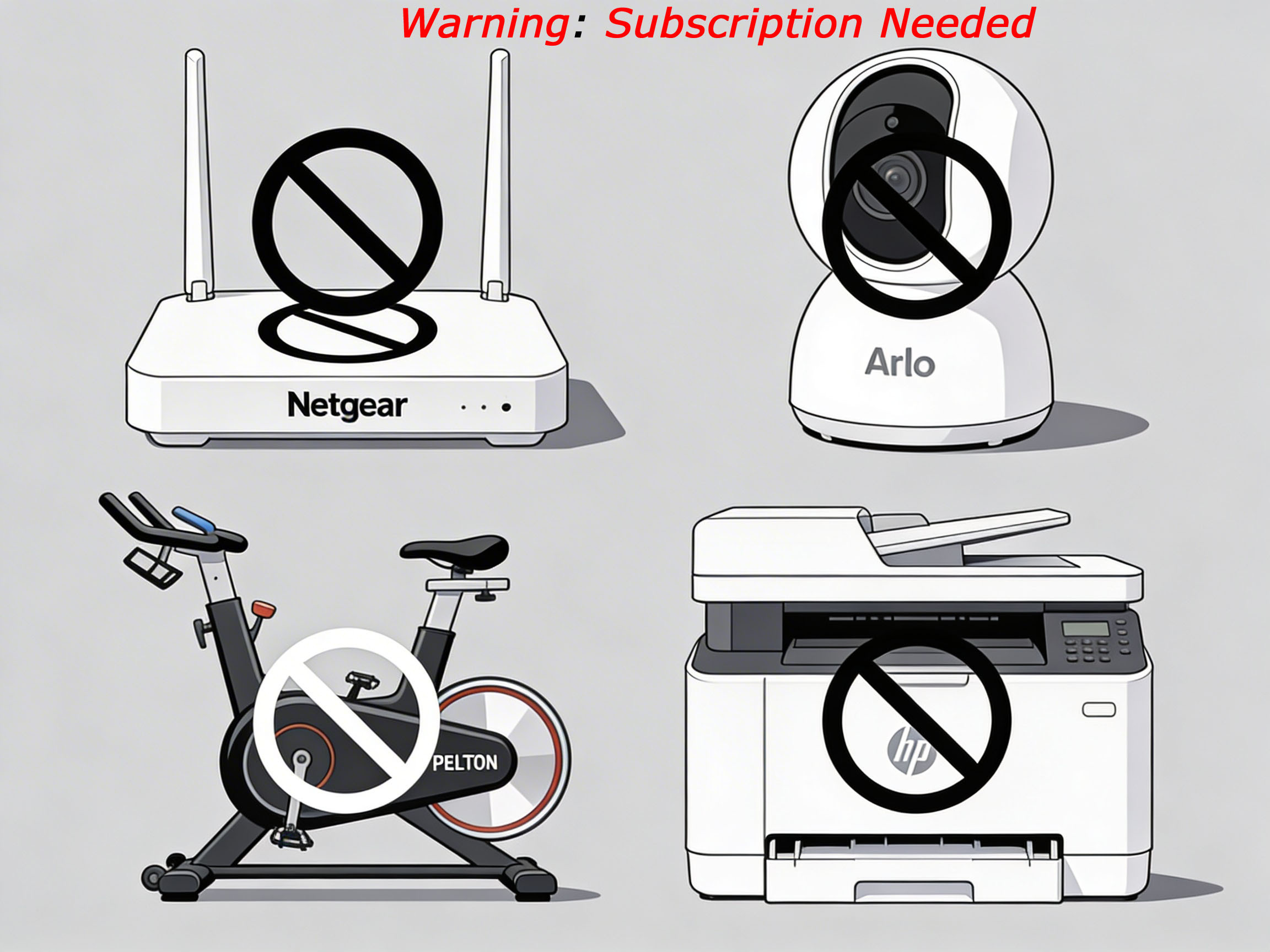
This starts with a minor mystery. In October 2019, my wife and I noticed that tufts of the wool rug in our dining room were coming off. It was sudden—the piles of wool around a new bald spot on the rug would happen overnight. It took me many years to get bald.
It must be a mouse, we agreed. But there were no tell-tale droppings that invariably accompany a mouse intrusion. Maybe moths, or more accurately their cloth-ingesting larvae. But a close examination found no evidence of larvae. Nor, in any event, did we think they could act so fast. An exterminator suggested it might be a squirrel or another rodent. But again, no droppings or indeed sighting of a larger critter scampering about our urban townhouse. A mystery.
Baffled, I fell back on technology. I purchased an Arlo security camera, downloaded the app, and placed it on the dining room floor. It was motion-activated. The next morning, I checked the app. Nothing. Literally. Although it was supposed to work in low light, there was no light, and all we saw was a black screen. If it were a mouse, leaving a light on would be more likely to keep it away. I tried it for a few nights, but nothing.
We never learned what shredded our rug, but it was denudded like a case of alopecia, and it had to be tossed out. The replacement rug, braided cotton, has been unscathed.
However, this is not about the rug, but about the Arlo security camera. After this brief use, I stored it away. Until last month. While we were away for a few weeks, a contractor planned to do some work on the house. My darling wife was a tad concerned about giving strangers access. My plan to reassure her was to resuscitate the Arlo, place it where it could see if anyone came into a room where they shouldn’t have been.
But in setting it up, all the app was able to show me was a read-time feed. There was no motion detection, nor storage of clips of any intrusion. Googling how to fix it, I discovered the camera had passed its EOL: end of life date. This is what I found on its Product Support page:
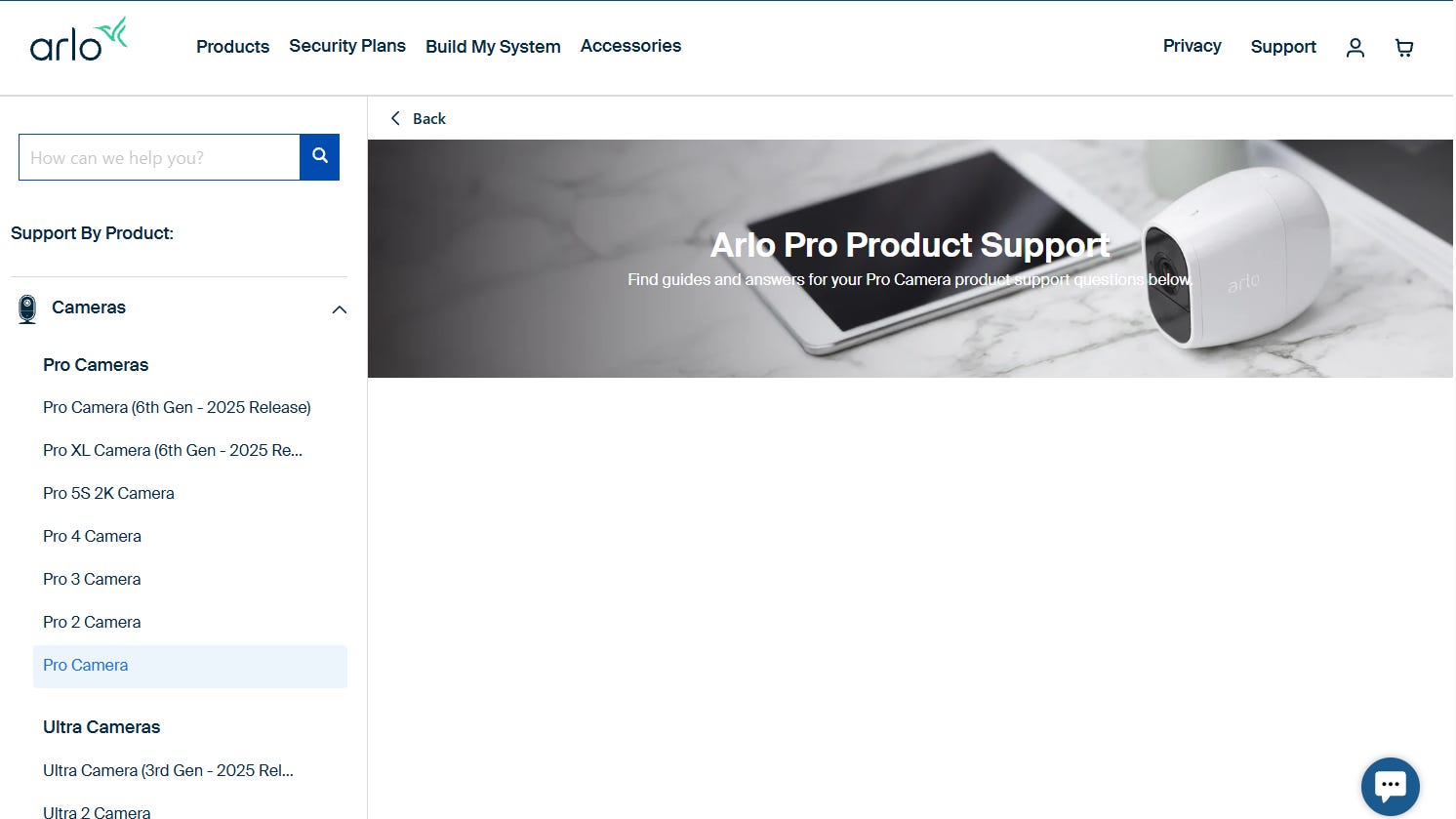
Yeah, nothing. On its FAQ page, Arlo informed me that EOL devices “no longer receive software or firmware updates.” According to Arlo (owned by Netgear), its cameras become EOL after four years. Translated: It doesn’t stop functioning but it won’t provide all the functionality I bought. The dictionary definition is “planned obsolescence.” This isn’t because the parts wore out. Arlo’s policy for EOL is four years. RIP, Arlo Pro. This is hardware as a service.
First, it was software as a service
Much software is now sold as a service. That is, provided on a subscription basis rather than a lifetime license. For example, legacy Microsoft Office is still available, for a one time price of $180. However, it offers no upgrades and Microsoft will stop providing security and bug fix updates in 2029.
Office has been rebranded as Microsoft 365, sold as a subscription of $100 annually for an individual and $130 for a family. Many of us have access through our employer-provided subscriptions. This does include regular updates to functionality, as well as some cloud backup and a few other goodies.
I’ve been using Quicken financial software for decades. At first, it allowed downloads of data from one’s financial accounts forever. I would upgrade—on my own volition—periodically when enough new functionality was offered. Today, it’s a subscription service. After three years, for most versions
you will have read/write ability but everything will be manual…. You will no longer be able to use any Online Services (i.e., OSU, Web Connect transaction downloads, Mobile, Quicken on the Web, download securities quotes, update home values via Zillow, update your credit score, use Portfolio X-ray, get program updates, etc.). You will also lose about 25% of your screen to a reminder to re-subscribe (this reminder cannot be turned off).
Another popular consumer software product sold solely by subscription is Adobe’s Acrobat and Creative Cloud (Photoshop). This is even more prevalent for business software: Autodesk, VMware, Salesforce, Oracle, and SAP, among many.
Then, hardware as a “service”
Now, hardware providers have found they can make their devices obsolete faster than the technology itself warrants.
The model is sometimes called “hardware as a service” or, less charitably, software-enforced planned obsolescence.
This is not a new concept. Passenger cars became so unreliable as they quickly aged that in the 1980s Volvo ran an advertisement touting how many of its brand were still on the road after 100,000 miles. Today, that mileage barely raises an eyebrow.
In the first decade of personal computers, the technology advanced so rapidly that a three-year-old PC was truly obsolete—not by plan but by rapid breakthroughs in key technologies. In 1979, Intel introduced its 8088 central processor unit (CPU: the computing power of the computer), used for IBM’s first PC. The much-improved 80286 was introduced three years later, and the 80386 three years after that. The 80486 arrived four years hence. Another four years and the Pentium CPU arrived. One doesn’t have to be immersed in bits and buses to appreciate the additional capabilities, such as displaying the graphics that Windows introduced, made possible by the faster processing capability of the newer CPUs. During this time, a three-year-old computer could really be unable to run the software being developed to take advantage of these advances.
Improvements over the past 20 years have been more incremental, such that a 10 year old PC is likely still able to access the internet and run older but functional versions of installed software such as Word.
Although smartphones have undergone many changes since the iPhone in 2007, they have not become outdated as fast as PCs had. The iPhone 6s, the newest model 10 years ago, had a 12-megapixel rear camera that could record up to 4K video, as well as a front camera, a Touch ID fingerprint sensor, and “Hey Siri” capabilities. Although the phone cannot run an operating system beyond iOS 15 (we’re up to iOS 26 today), Apple released a security update as recently as January. The phone is still serviceable today for calls, texts, photos, emails, and many of the apps it had installed.
However, like my Arlo Pro, it seems like more technology hardware manufacturers are ceasing “support” after a period of time. What are some other examples of hardware manufacturers making their products, just a few years old, effectively obsolete, requiring the purchase of new hardware?
Smart Home & Security. Arlo is far from alone. Nest (now Google) dropped support for its original Learning Thermostat and first-gen Nest Protect smoke detectors, rendering them far less useful. Insteon, a major smart home hub company, simply shut down its servers in 2022 with virtually no warning, instantly bricking thousands of customers’ devices that depended on cloud connectivity.
Fitness & Wearables. Peloton has disabled features on older bikes and charges subscription fees for functionality that was originally included. Essentially, spending $2500 for the equipment is just the entry point. My Oura ring is mostly just some ugly jewelry without a $6 monthly subscription for the app.
Printers. HP has been particularly aggressive here, using firmware updates to block third-party ink cartridges — effectively degrading hardware you already own unless you pay for their ink. Some users have found their printers refusing to work after an automatic update.
Smart TVs from Samsung, LG, and Vizio: Older models have had streaming apps like Netflix or Disney+ removed or made non-functional because the manufacturers stopped updating the platform software — even on TVs that work perfectly as displays.
Gaming. Sony had planned to shut down the PlayStation 3 and PS Vita online stores, though community backlash pressured it to retreat from that. However, Nintendo did shut down the Wii U and 3DS online services in 2024, eliminating functionality that was central to those devices.
Routers & Networking Linksys, Netgear, and others routinely end security updates for routers after just 3-5 years, leaving them vulnerable and increasingly incompatible with modern services.
Why the spread of hardware as a service now?
The common thread is that manufacturers have discovered they can leverage internet connectivity and cloud dependency. By tying hardware functionality to apps, servers, or subscriptions, they effectively rent you the full functionality of something we often thought we bought outright. The Right to Repair movement has pushed back on this, and the EU, in particular, has been pursuing regulations requiring manufacturers to provide longer support windows and spare parts. In the U.S., the Federal Trade Commission under the Biden Administration began scrutinizing the practice, but it would be surprising if it were a priority under the Trump FTC. Legislation has been slow to keep pace with technology.
The economics driving the subscription models
Software as a service (SaaS) is an attractive business model for the sellers. For us consumers, there are two sides. For businesses, it smooths unpredictable, lumpy revenue into a predictable stream. When a company sells a lifetime license, it books that revenue once and then has to keep selling to new customers to grow. With subscriptions, the initial revenue is lower, but it compounds as existing customers keep paying while new ones are added on top. A business with 10,000 customers paying $50/month has a relatively stable $500,000 in monthly revenue to plan around. The equivalent one-time-license business has no such guarantee next month. Wall Street loves this, and it’s a big reason why SaaS companies command such high valuations.
Beyond revenue predictability, there are several other compelling advantages:
Lock-in and switching costs. Once a customer’s workflows, data, and integrations are built around a SaaS product, leaving is painful. This gives the vendor enormous pricing power over time. For example, a small business considering switching its accounting software.
Usage data. Cloud-delivered software gives vendors a continuous stream of data about how their product is used, enabling rapid iteration and targeted upselling.
Reduced piracy. A cloud-hosted service is very hard to pirate compared to a piece of installed software.
There are some benefits for some consumers.
Consumers can try new software for a lower entry price. A $10/month subscription is psychologically and financially easier for a customer to say yes to than a $500 perpetual license, even if the subscription’s lifetime cost is higher. This expands the potential market for the manufacturer but also reduces the upfront commitment from users (subject to the learning curve and the switching cost noted above).
Second, because the customer is always paying, the vendor has a greater obligation to continually improve and support the product. This creates a virtuous cycle — as the vendor can push updates, new features, and other changes as they develop. Users always have the latest and greatest.
At Nova Systems, the software business I co-founded in 1986, we charged about $15,000 for our system (about $48,000 today), including on-site installation. However, I can reinforce that sales were lumpy: feast and famine, rinse and repeat. To help, we offered maintenance contracts for a few thousand dollars annually. That started to provide cash during the famine months. Our software would continue to work, but it was complex enough that few customers wanted to master the code and the system's intricacies.
Does the same model apply to Hardware as a Service?
Many of the same financial incentives exist, but there are some important structural differences that make it both more complicated and, in some ways, even more powerful for manufacturers — and more problematic for consumers.
The model works the same way in that the recurring revenue logic applies just as strongly. If a manufacturer can tie hardware functionality to a cloud service or subscription, they get the same predictable revenue stream. They can also use the model to lower upfront purchase prices (making the hardware easier to sell) while recouping margin over time through ongoing fees — the same razor-and-blades model that Gillette pioneered a century ago.
Where hardware differs — and why hard as a service is arguably more controversial
Most critically, physical goods carry a stronger expectation of ownership. When we buy a piece of software, we understand that we are buying a license, not the code itself. When we buy a physical object — a thermostat, a security camera, a printer, a computer, a smartphone — the cultural and legal expectation is that we own it outright and can use it as we see fit, until it breaks or we choose to replace it. Manufacturers degrading that physical object’s functionality through software updates feels like a much more direct violation of ownership norms.
Hardware has real production costs. Software doesn’t. A software company’s marginal cost1 of serving one more subscriber is essentially zero. A hardware company has already spent money on components, manufacturing, and shipping each unit. This means the financial pressure to extract ongoing revenue is actually higher for hardware makers, but the consumer goodwill risk is also higher when they do so.
Hardware does wear out; software doesn’t degrade. A piece of software works identically on day one and day ten years later. Hardware physically ages, which can provide some natural justification for obsolescence. But as my Arlo example shows, hardware is often made obsolete by software decisions long before the physical device fails. The camera itself still works perfectly.
Hardware switching costs are higher for consumers. For example, switching from one project management SaaS to another is annoying but doable. Replacing a home with multiple smart thermostats, a security camera system, or the family’s smartphones involves physical effort, installation costs, and disruption. This gives hardware manufacturers who achieve lock-in even more pricing power than their SaaS counterparts.
Repair and consumer protection laws are more developed for physical goods. The Right to Repair movement, lemon laws, and product liability frameworks all apply to hardware in ways they don’t to software. This creates some legal risk for manufacturers who push too hard, and is one reason the EU has been pushing more aggressively to regulate hardware obsolescence practices.
The bottom line
Hardware as a service is financially very attractive to manufacturers for all the same reasons SaaS is attractive to software companies — and then some, given the higher switching costs. But it carries greater reputational and legal risk because it so clearly conflicts with consumers’ intuitive sense of what it means to own something. The companies doing it most aggressively are essentially betting that customers either won’t notice, won’t care enough to switch, or simply have no good alternative. So far, in many categories, that bet has been paying off. I haven’t replaced the Arlo, but did install a Ring doorbell—and purchased a subscription.
For the non-economists, that is the cost of producing one more unit. Pre-internet, there was some cost for software, for the disks, the packaging, and the discount retailers required off the list price.
The second side is simply more $ for the manufacturer and less choice for me as to how much (hardware function) do I need, what upgraded functionality is meaningful for me, etc. so you point me to focus more on how to make hardware decisions, thanks!
Seems similar to the path dependence that locks us into an array of unwelcome product choices because the cost (including the hassle factor) of leaving, let's say Apple for Dell, is too high.